

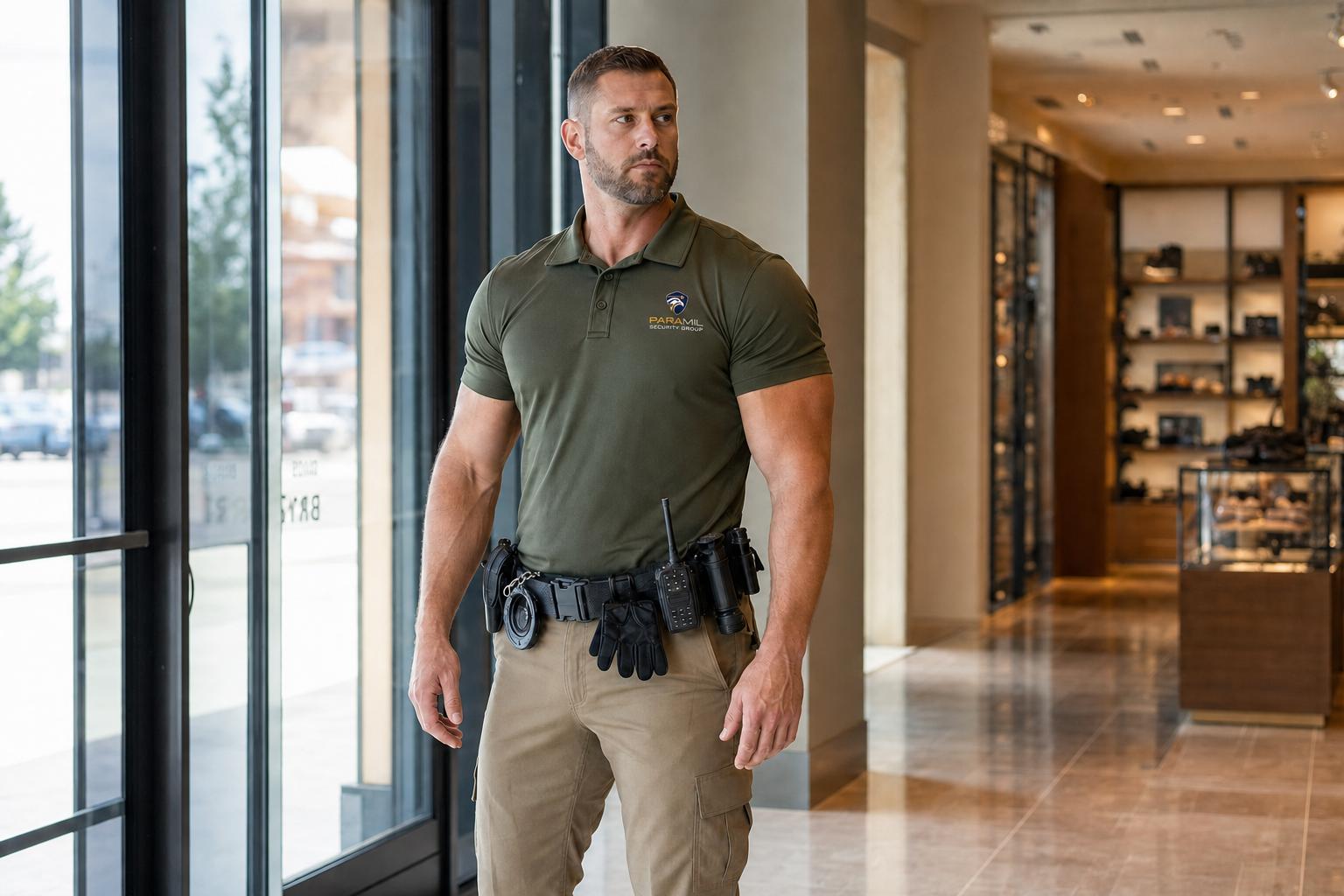
Retail doesn’t need a guard.
It needs an operator.
Shrink, organized retail crime, and aggressive offenders are no longer a back-office problem. ParaMil deploys vetted, uniformed loss-prevention operators trained to deter, document, and de-escalate — from a single flagship store to a national multi-location program.
The retail floor changed.
Your security needs to as well.
The threat is no longer petty shoplifting. It is organized, coordinated, and increasingly violent. A reactive guard contract is not a strategy.
U.S. retailers are projected to lose $47.8 billion to theft in 2025, and shoplifting incidents have climbed 93% since 2019. Three out of four retailers report that offenders are more aggressive and more violent than ever.
Standard mall-guard contractors are minimum-wage, minimum-training, and minimum-presence. They deter no one. ParaMil operators look, move, and decide differently — because they come from a different bench.
- Background: Former military, federal LE, and professional protective backgrounds — not entry-level guards.
- Posture: Visible deterrent at entrances & choke points; plainclothes overwatch on request.
- Doctrine: Deter first, document second, detain only when policy & law authorize.
- Coordination: Direct radio link to store leadership and local LE liaison protocols.
Three postures. One standard.
Coverage is engineered around your shrink data, store footprint, and brand standards. Operators are placed where the data says incidents start — not where it is easiest to stand.
Uniformed Deterrent
High-visibility operator in branded polo and duty belt. Posted at entrances, choke points, and high-shrink categories. Designed to influence the offender’s risk calculation before they cross the threshold.
Plainclothes Overwatch
Discreet floor presence trained in surveillance detection and behavioral indicators. Coordinates with uniformed staff via radio. Optimal for organized retail crime, return-fraud rings, and repeat offenders.
Hybrid Detail
Layered coverage — uniformed presence at the door, plainclothes inside, and a designated incident lead. Standard for flagship locations, peak retail windows, and stores with documented ORC activity.
Different bench. Different outcome.
Every ParaMil retail operator is screened, vetted, and trained against a documented standard. We do not staff your store with whoever is available this shift.
Background
Former military, federal law enforcement, or career protective backgrounds. No entry-level guards. Every operator passes a documented background, drug, and reference screen.
Training Standard
Use-of-force law, retail trespass procedure, de-escalation, defensive tactics, incident documentation, and active-threat response — certified to a documented pass standard before posting.
Doctrine
Deter first. Document second. Detain only when policy and law authorize, and only when it can be done safely. Operators are trained to protect your liability posture as carefully as your inventory.
Coordination
Direct radio link to store leadership. Established liaison protocols with local law enforcement. Daily incident reporting and weekly trend briefings to your asset protection lead.
Presentation
Branded polo, duty belt, professional grooming. Operators look the part because the visual signal is the first line of deterrence. Plainclothes details dress to your store’s customer profile.
Continuity
Dedicated operators per location — not a rotating roster. Your team learns your floor, your repeat offenders, and your peak windows. Reduced turnover means better intelligence.
ORC investigation & after-action support.
The 10% of offenders driving 68% of loss are organized. The response has to be too. ParaMil pairs floor coverage with licensed investigative capability under one engagement.
Licensed investigators document repeat offender patterns, build case files for prosecution, and coordinate with retail crime units and district attorneys. Reports are court-admissible.
Covert surveillance on identified ORC networks. Vehicle tracking, photographic evidence, and pattern-of-life documentation that converts shrink data into closed cases.
- Daily: Incident logs with timestamps, video references, and witness statements where available.
- Weekly: Trend analysis — categories hit, peak windows, repeat-offender flags.
- Quarterly: Program review with measured shrink delta and recommended posture adjustments.
Built to your footprint.
Single-store coverage to multi-location programs. We scope to what the data actually shows.
Every engagement begins with a confidential assessment.
We review your shrink data, incident history, store footprint, and brand standards before proposing posture. Pricing is structured around shifts, locations, and required tier — not generic hourly rates.
Protect your floor. Protect your people.
A 30-minute confidential consultation is the first step. We listen, we scope, and we deploy a posture built around your store.
Request Consultation